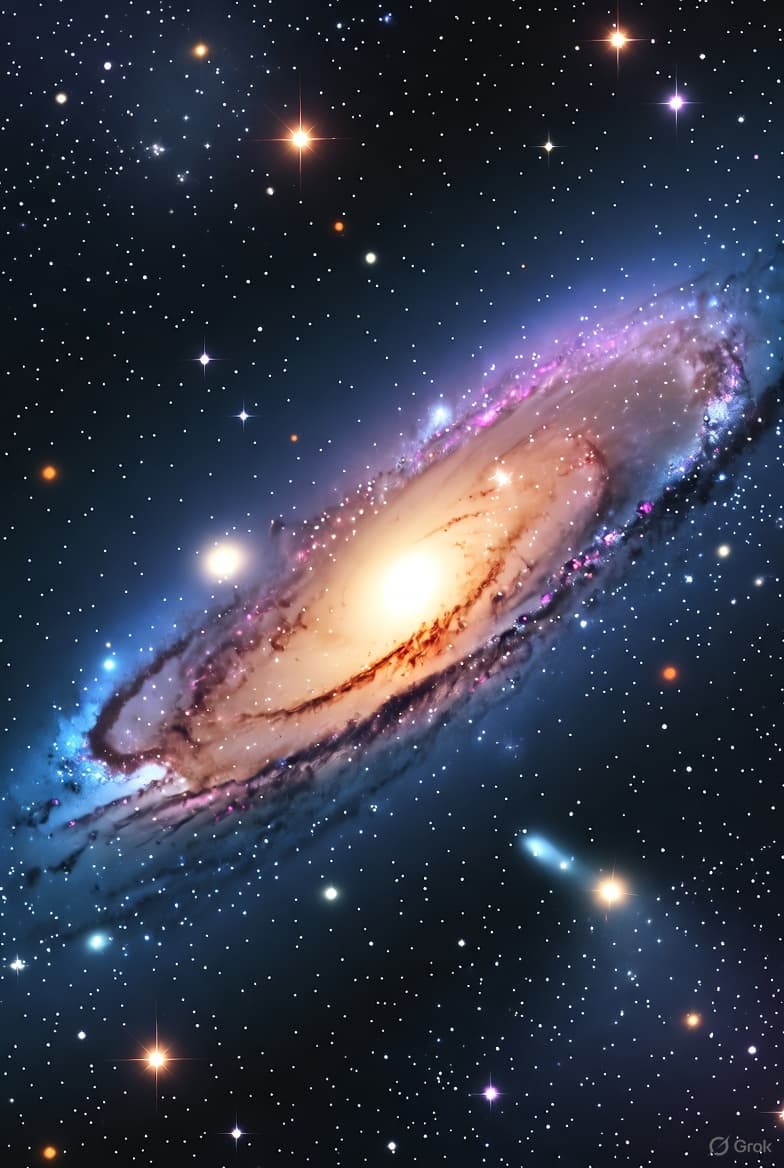
The Context
The universe isn't random. On the largest scales, galaxies aren't scattered uniformly through space — they're arranged along an intricate scaffolding of dark matter filaments, gas streams. Having tracked this for a while, and dense clusters separated by enormous voids (a pattern we keep seeing).
Cosmologists call this the cosmic web. And understanding its structure is fundamental to explaining how the universe evolved from a nearly featureless cloud of hydrogen after the Big Bang into the rich tapestry of galaxies we observe today.
For decades, astronomers have tried to map this web in detail. The Hubble Space Telescope gave us tantalizing glimpses through deep-field observations. But its infrared capabilities were limited. Actually, that understates it. Ground-based surveys could cover wide areas but lacked the depth to peer into the universe's earliest epochs. The cosmic web's faintest filaments — especially those stretching back billions of years — remained frustratingly out of reach.
That changed with the James Webb Space Telescope. Since its launch in December 2021, JWST has been systematically pushing the boundaries of what's observable. And its most ambitious general observer program has now delivered results that rewrite our understanding of large-scale structure across nearly the entire history of the universe.
The Development
In May 2026, astronomers published results from COSMOS-Web — the largest General Observer program selected for JWST's first observation cycle. The survey mapped 0.54 square degrees of sky using the Near Infrared Camera (NIRCam) and 0.2 square degrees with the Mid Infrared Instrument (MIRI), covering an area roughly equivalent to three full moons. Within that patch, the team analyzed more than 164,000 individual galaxies to construct the most detailed map of the cosmic web ever created.
The results trace the web's skeleton-like framework of dark matter, gas filaments. And dense sheets surrounding vast cosmic voids — all the way back to when the universe was barely one billion years old. As we've explored in The James Webb Space Telescope: Revolutionizing Our Understanding of the Universe, Webb's infrared sensitivity dwarfs that of any predecessor.Where Hubble's observations of the same COSMOS field smoothed structures together. JWST resolves individual filaments and node points with startling clarity.
The broader COSMOS2025 catalog, released alongside the cosmic web analysis, contains photometry, morphological measurements, redshifts. And physical parameters for nearly 800,000 galaxies. This represents an extraordinary jump in data density — the kind of dataset that enables not just single discoveries but entire analysis programs. UC Riverside astronomers leading the project described it as moving from a blurry satellite photo to a detailed street map of the universe's architecture.
What This Changes
The implications cut across multiple branches of astrophysics. Dark matter remains invisible directly, but its gravitational influence shapes the cosmic web. By mapping the web's filaments with this precision, researchers can constrain dark matter distribution models far more tightly than before. If the web's structure at high redshift matches certain theoretical predictions better than others, it narrows the field of viable dark matter candidates — a question that has resisted resolution for decades.
Galaxy evolution research benefits equally. Understanding why galaxies cluster where they do — at the dense nodes of the web — requires knowing the web's architecture at different cosmic epochs. The COSMOS-Web data reveals how filaments evolved over 13.7 billion years, showing where gas flows into galaxies along these cosmic highways and how that infall drives star formation. At the same time, connection between a galaxy's position in the web and its star-forming activity is now directly measurable across vast stretches of cosmic time.
For observational cosmology, this dataset also provides an independent check on models of the universe's expansion rate. The distribution of matter in the cosmic web is sensitive to cosmological parameters including the Hubble constant and the density of dark energy. Tensions between different measurements of these values — the so-called "Hubble tension" — could find resolution or deepening contradictions as researchers feed COSMOS-Web data into their models. As covered in James Webb Telescope vs. Hubble: What's the Difference?, JWST's design was always intended to answer precisely these kinds of cosmological questions.
Looking Forward
The first public data release began in 2025, with updated morphological measurements and large-scale structure density maps continuing through 2026 and beyond. Future JWST cycles will extend coverage to additional fields, and planned ground-based surveys like the Vera C. Rubin Observatory's Legacy Survey of Space and Time will provide complementary wide-field data that can be cross-referenced with COSMOS-Web's depth.
Perhaps most striking is the timing. Well, more precisely, just weeks before the cosmic web results, a separate JWST team reported the strongest evidence yet for Population III stars — the universe's theorized first generation of stars, detected near the galaxy GN-z11 at a time just 400 million years after the Big Bang. Taken together, these discoveries suggest we're entering an era where the universe's earliest chapters are no longer inaccessible theoretical territory but observable, measurable reality. To clarify: the cosmic web map gives us the scaffolding. Now we can watch how the first stars and galaxies built upon it.
Sources: COSMOS-Web DR1 / UC Riverside (May 2026), Science Daily (May 11, 2026), Astronomy & Astrophysics — COSMOS2025 catalog, Phys.org — Population III star evidence (April 2026)